Quick Answer
AI document verification analyzes document images and extracted data for inconsistencies, anomalies and suspicious patterns that may indicate fraud. It typically works alongside OCR, computer vision, machine learning and data validation to generate a risk signal, which then determines whether a document passes automatically, gets rejected, or gets escalated for human review. AI does not guarantee that every document is authentic or catch every fraud attempt.
Introduction
Organizations today process huge volumes of identity documents, academic certificates, financial records and employment paperwork, far more than any manual review team could reasonably check by eye. Fraud detection has never been just about reading text on a page either. It involves spotting subtle inconsistencies in formatting, data and structure that a tired reviewer working through their fiftieth document of the day is likely to miss.
AI doesn’t replace verification. It strengthens the verification workflow. At ZeoVerify we build exactly this kind of AI assisted pipeline for universities, banks and consultancies. This guide walks through how AI actually detects document fraud, what it can and cannot do, and where human judgment still fits into the picture.
TL;DR
- AI analyzes document images and extracted data for patterns associated with fraud
- OCR extracts text, computer vision analyzes visual characteristics, and machine learning flags anomalies
- Risk signals feed into a decision: automatic pass, rejection, or escalation to a human reviewer
- AI improves consistency and speed but does not guarantee it catches every fraud attempt
- Human review remains an important part of the process for ambiguous or high risk cases
What Is AI Document Verification?
AI document verification refers to using artificial intelligence, alongside supporting technologies, to analyze documents for authenticity and consistency rather than relying purely on manual inspection.
It helps to distinguish a few related technologies here. OCR extracts text and data from a document. Automation executes predefined workflows and rules without necessarily understanding content. AI, specifically machine learning and computer vision, analyzes patterns and anomalies and supports a more adaptive kind of assessment that can adjust as it encounters new examples. Most modern verification platforms combine all three, along with pattern recognition and anomaly detection, into a single pipeline. For a broader look at how this fits into the full verification process, see our complete guide to document verification software.
Why Is AI Needed for Document Fraud Detection?
Manual verification becomes difficult to sustain once document volume grows past what a small team can handle. Repetitive checking leads to fatigue, and fatigue leads to inconsistent review, especially as forgery techniques get more sophisticated and harder to spot with the naked eye.
AI document fraud detection helps close this gap by applying the same analysis consistently to every document regardless of volume, catching signals a rushed human reviewer might miss. This does not mean AI replaces human verification entirely. It means the manual bottleneck gets automation and AI assistance for faster analysis, with consistent risk signals feeding into human review wherever it is genuinely needed. For more on the broader case for automation, see our piece on the top benefits of document verification software.
How Does AI Document Verification Work?
The process generally follows a consistent pipeline, moving from raw upload to a final decision.
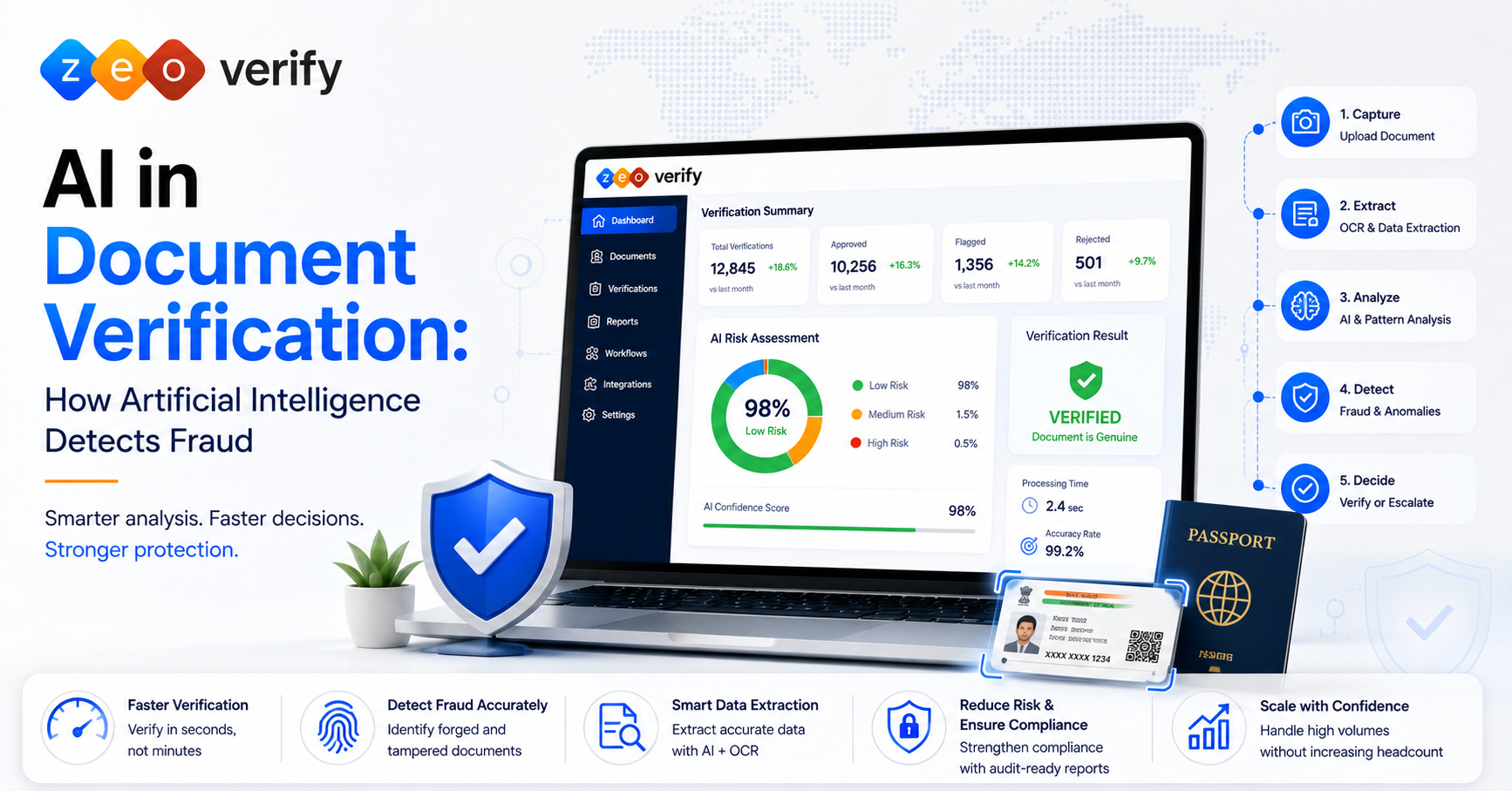
Capture → Quality Analysis → Classification → OCR → AI Analysis → Consistency Checks → Fraud/Anomaly Detection → Risk Assessment → Decision → Human Review
Step 1: Document Capture and Image Quality Analysis
The system first checks whether the submitted image is actually usable, flagging blur, poor lighting or cropping before wasting effort further down the pipeline.
Step 2: Document Classification
AI identifies the document type, whether a passport, ID card, certificate or financial document, so the right verification checks apply to the right document.
Step 3: OCR and Data Extraction
OCR reads the document and converts text into structured data, creating fields that later steps can analyze and cross check.
Step 4: AI and Computer Vision Analysis
The system looks beyond text, examining layout, fonts, images and overall structure for characteristics that deviate from known genuine formats.
Step 5: Data and Consistency Checks
Extracted information gets compared against expected formats and related fields. A mismatch between two fields that should agree becomes a risk signal worth flagging.
Step 6: Fraud and Anomaly Detection
This is the core fraud detection function, turning visual and data analysis into concrete anomaly or risk signals rather than a simple pass or fail judgment.
Step 7: Risk Scoring and Verification Decision
Multiple signals combine into an overall risk score that determines whether a document moves forward automatically, gets rejected, or gets flagged for closer review. Exact scoring methods vary by provider.
Step 8: Human Review and Exception Handling
Ambiguous or high risk results get routed to a human reviewer for a final call. This human in the loop model matters because AI should never be treated as infallible.
How Does AI Detect Fake and Forged Documents?
AI can identify a range of signals associated with AI fake document detection and AI forged document detection, though it cannot guarantee it catches every fraud attempt, and results depend heavily on document quality and how well the system has been trained on relevant examples.
| Fraud Type | AI Signal | Detection Method | Possible Outcome |
|---|---|---|---|
| Physical or digital tampering | Visual inconsistency | Image and pattern analysis | Flagged for review |
| Conflicting data fields | Mismatched information | Data validation and cross checking | Risk signal raised |
| Unusual layout or structure | Deviation from known templates | Pattern recognition | Anomaly flagged |
| Statistically unusual characteristics | Outlier patterns | Machine learning anomaly detection | Escalated for review |
| Fabricated academic documents | Inconsistent formatting or issuing details | Template and consistency analysis | Flagged for verification |
Detecting Document Tampering, Inconsistent Data and Suspicious Patterns
Visual inconsistencies such as irregular spacing, mismatched fonts or signs of digital editing get picked up through image analysis. When fields that should logically agree with each other do not, such as a date of birth that conflicts with an age listed elsewhere, data validation flags the conflict. Computer vision also compares a document’s expected structure against what it actually observes, flagging layout anomalies without needing to expose exactly which cues triggered concern.
Detecting Anomalous Characteristics, Academic Documents and Identity Documents
Machine learning models trained on known genuine and fraudulent examples can flag documents whose characteristics fall outside expected patterns, even when nothing obviously wrong jumps out to a human eye. AI academic document verification applies this same pipeline to transcripts and certificates, checking formatting against known institutional templates, though human review still matters given how much academic formats vary between schools and countries. AI identity document verification applies the same logic to passports and national IDs, generating risk indicators that feed into the same overall workflow.
AI vs Manual Document Verification
| Factor | Manual Verification | AI Assisted Verification |
|---|---|---|
| Speed | Dependent on reviewer workload | Automated analysis accelerates routine checks |
| Scalability | Limited by staffing | Better suited to high volume workflows |
| Consistency | Can vary by reviewer | Standardized, system based checks |
| Fraud detection | Human expertise | AI assisted pattern and anomaly analysis |
| Human judgment | High | Used especially for exceptions |
| Complex cases | Human assessment | Often escalated to human review anyway |
The honest framing here is AI assistance versus human judgment, not a straight replacement. For a deeper comparison, see our full breakdown of manual vs automated document verification.
AI vs OCR vs Automation: What’s the Difference?
These terms get used almost interchangeably, but they describe different things.
| Technology | Primary Role | Example in Verification |
|---|---|---|
| OCR | Extracts text and data | Reads names and document numbers |
| Automation | Executes predefined workflows | Routes documents and triggers tasks |
| AI/ML | Analyzes patterns and anomalies | Identifies potentially suspicious characteristics |
| Computer vision | Analyzes visual information | Examines document structure and images |
These technologies are complementary rather than interchangeable, and most real verification pipelines use all of them together rather than relying on just one.
Benefits of AI Powered Document Verification
Benefits of AI document verification tend to follow a fairly consistent pattern across organizations that adopt it: faster verification workflows compared to manual review alone, higher processing capacity without a proportional staffing increase, more consistent checks applied across every document, stronger fraud detection support through pattern analysis, reduced repetitive manual work for verification staff, better user experience through faster turnaround, structured risk assessment instead of subjective judgment calls, and improved workflow visibility through digital records.
Where Can AI Document Verification Be Used?
Universities and consultancies use AI to check transcripts and certificates faster during high volume admissions periods, with human review still available for unfamiliar formats. Financial institutions apply AI assisted checks to identity and financial documents as part of onboarding, generating risk signals that feed into broader KYC workflows. Insurance companies use it for claims and policyholder documents, HR teams for employment verification, and healthcare and government organizations for identity confirmation across large volumes of applicants.
What Are the Limitations of AI Document Verification?
It would be misleading to present AI as a flawless solution. Honest limitations include false positives that flag genuine documents incorrectly, false negatives that let fraudulent documents slip through, reduced reliability with poor image quality, difficulty with unusual or unfamiliar formats, new fraud patterns the system has not encountered before, limitations tied to training data quality and scope, privacy and data security considerations, integration complexity during implementation, and a continued need for human review in ambiguous cases.
How to Choose AI Document Verification Software
When evaluating AI document verification software, work through these questions with each vendor.
- What document types does it actually support?
- How strong are its OCR capabilities?
- What specific AI and machine learning capabilities does it offer?
- How does it handle false positives and edge cases?
- Is human review built into the workflow?
- Are APIs and integrations available for your existing systems?
- What security and privacy controls are in place?
- Can it scale with your growing document volume?
- Does it provide audit trails and reporting?
- What does implementation and total cost of ownership actually look like?
How to Measure the Effectiveness of AI Document Verification
| KPI | What It Shows |
|---|---|
| Average verification time | Processing efficiency |
| Automated verification rate | Level of automation achieved |
| Manual review rate | Volume of exceptions requiring human review |
| False positive rate | Unnecessary escalations |
| Fraud flags | Volume of potentially suspicious documents |
| Cost per verification | Operational economics |
The Future of AI in Document Verification
Expect more advanced AI models, multimodal analysis combining multiple data types, tighter integration with digital identity systems, closer to real time verification, and greater interoperability between platforms. Human and AI collaboration is likely to remain central to this rather than AI operating fully independently, at least for the foreseeable future. Treat these as emerging directions rather than capabilities already fully proven at scale.
Key Takeaways: How AI Detects Document Fraud
AI analyzes document images and data for signs of fraud, OCR extracts the structured information that makes this analysis possible, computer vision and machine learning identify anomalies and suspicious patterns, and risk signals support the verification decision. Human review remains genuinely important for ambiguous or high risk cases, and no organization should treat AI as a fraud proof guarantee.
Conclusion
AI has become a meaningful part of how modern organizations detect document fraud, not by replacing human judgment but by handling the repetitive pattern analysis that no team could reasonably do by hand at scale. Combined with OCR, computer vision, data validation and a solid human review process, it gives organizations a far more consistent way to catch fraud than manual review alone ever could.
This is exactly the kind of system we have built at ZeoVerify, combining AI powered analysis with human oversight for the cases that genuinely need it. If your organization is exploring how AI powered document verification could fit into your existing workflow, it’s worth seeing how a modern platform handles your specific document types. Explore ZeoVerify to see how it fits your organization’s requirements.