Quick Answer
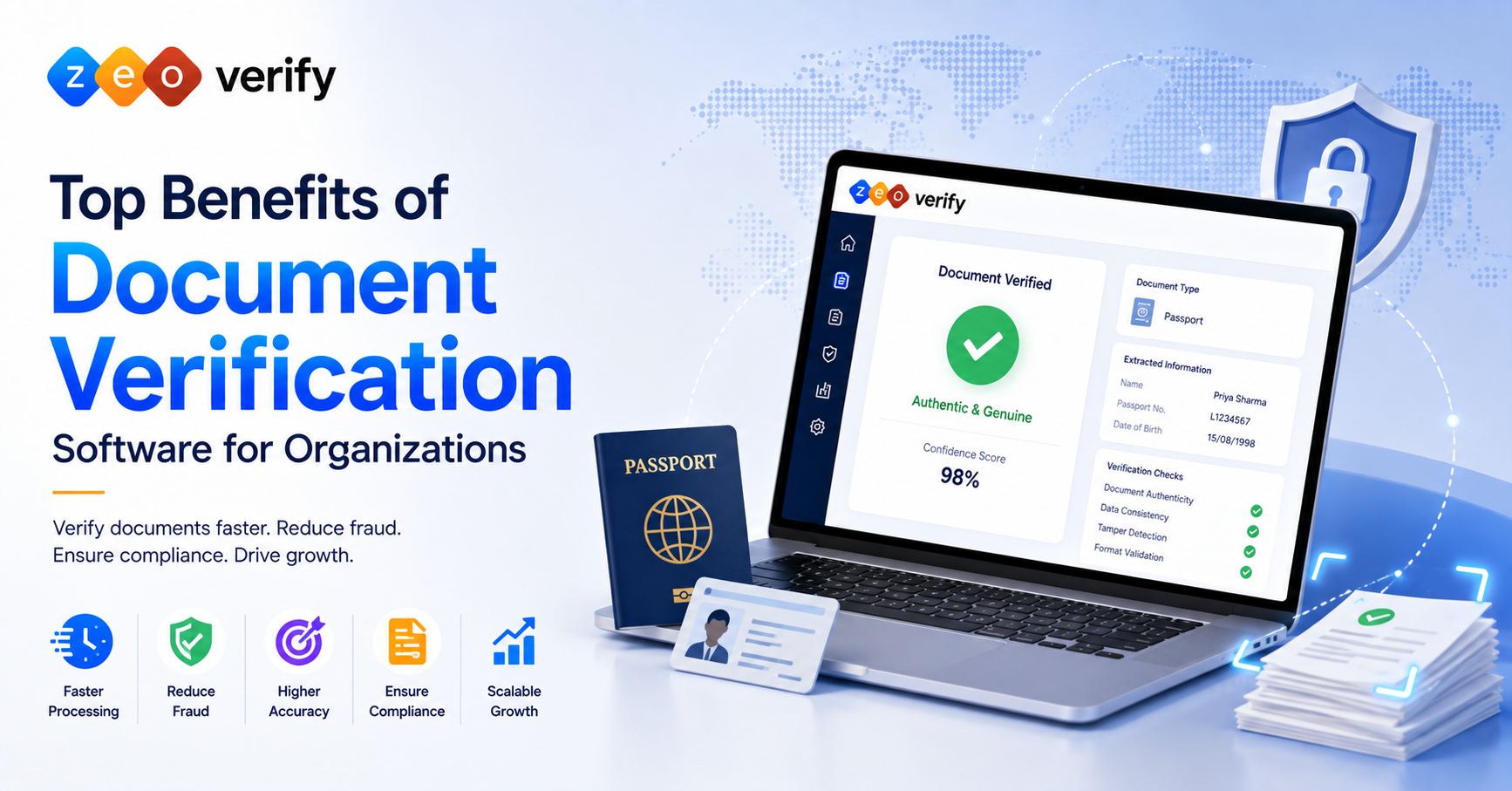
The core benefits of document verification software include faster processing, reduced fraud, better regulatory compliance, lower operational costs, higher accuracy, improved customer experience and the ability to scale onboarding without adding proportional staff. Organizations that switch from manual review typically see the biggest gains in speed and consistency.
Introduction
At some point, every organization that verifies documents for a living hits the same wall. Volume grows, manual review cannot keep up, and the cost of checking each document by hand starts eating into time that should go toward actual work.
That is exactly the gap document verification software closes. At ZeoVerify we work with universities, financial institutions and consultancies that all hit this wall at different points, and the benefits they see once they automate tend to follow a pretty consistent pattern. This guide walks through what those benefits actually look like in practice, not just as a marketing checklist.
TL;DR
- Automated verification is faster, more consistent and easier to scale than manual review
- Fraud detection improves through pattern based checks that a human eye often misses
- Compliance gets easier thanks to built in audit trails and structured record keeping
- Operational costs drop as staff spend less time on repetitive document checks
- Customer and applicant experience improves with faster turnaround and fewer errors
Why Organizations Need Document Verification Software
Before getting into individual benefits, it helps to understand the underlying problem. Manual document review does not scale linearly. Doubling your document volume usually means doubling your review staff, and even then, consistency suffers as more people apply their own judgment to the same task.
Document verification software breaks that link between volume and headcount. It applies the same checks to every document regardless of how many come in that day, which is the foundation almost every other benefit on this list builds on.
Faster Processing and Turnaround Time
One of the most immediate benefits of automated document verification is speed. What takes a human reviewer several minutes per document, automated systems typically handle in seconds.
This matters more than it might seem at first. Faster verification means faster onboarding, faster admissions decisions, and faster account approvals, all of which directly affect how quickly your organization can move people through a process that used to create a bottleneck.
| Verification Method | Typical Time per Document |
|---|---|
| Manual review | Several minutes |
| Automated verification | Seconds |
| Hybrid (automated with exceptions escalated) | Seconds for most, minutes for flagged cases |
Reduced Fraud and Better Document Authenticity
Fraud detection is one of the clearest advantages of document verification software over manual review. Automated systems check for signs of tampering, mismatched security features and inconsistencies in formatting that a busy human reviewer can easily miss, especially when working through a large stack of documents in one sitting.
This does not mean automated systems catch everything. No verification method is completely foolproof. But the consistency of automated checks means fraud detection does not degrade over the course of a long shift the way human attention naturally does.
Improved Accuracy and Consistency
Manual verification depends heavily on the individual reviewer’s experience, attention and even their mood on a given day. Automated systems apply the exact same criteria to every document, every time, which is one of the more underrated document verification software benefits.
This consistency matters especially for organizations operating across multiple locations or teams, where different reviewers might otherwise apply slightly different standards without realizing it.
Better Regulatory Compliance
Industries like banking, insurance and education face real compliance obligations around identity and document verification, often tied to KYC and AML requirements. Automated systems typically log every verification decision automatically, creating a clean, structured record that is far easier to produce during an audit than scattered paper files or inconsistent manual notes.
- Structured, timestamped verification records
- Consistent application of compliance rules across every document
- Easier reporting when regulators or auditors request documentation
- Reduced risk of human error causing a compliance gap
Lower Operational Costs
The benefits of document verification extend directly to the bottom line. Manual review requires staff time, training and ongoing management, all of which scale with volume. Automated verification shifts much of that cost toward software rather than headcount, and the savings tend to compound as volume grows.
It is worth noting that automation is not free. There is a real cost to implementation, integration and ongoing maintenance. But for most organizations processing meaningful volume, the total cost per document still comes out lower than continuing to scale a manual team.
Higher Scalability for Growing Organizations
This is one of the most practical reasons organizations need document verification software. A manual team that can handle a hundred documents a day cannot suddenly handle a thousand without a proportional jump in staffing. Automated systems handle that same jump with far less friction, since the software does not get tired or need training the way a new hire does.
For universities during peak admissions season, or financial institutions during a promotional signup surge, this kind of elastic capacity often makes the difference between a smooth process and a backlog that frustrates everyone involved.
Improved Customer and Applicant Experience
Nobody enjoys waiting days for a document check to clear. Faster, more reliable verification translates directly into a better experience for the person on the other end, whether that is a student applying for admission, a customer opening a bank account, or a job candidate completing onboarding.
Reduced friction here has real downstream effects. Faster verification means fewer abandoned applications, fewer frustrated support calls asking about status, and a generally smoother first impression of your organization.
Stronger Data Security and Audit Trails
Automated document verification systems typically come with structured access controls and detailed logs of who viewed or processed which document and when. This is a meaningful improvement over manual processes, where sensitive documents like passports and financial records can end up scattered across email inboxes and shared drives with far less oversight.
| Security Aspect | Manual Process | Automated System |
|---|---|---|
| Access control | Often informal | Role based and structured |
| Audit trail | Inconsistent | Automatic and detailed |
| Document storage | Scattered across tools | Centralized |
| Data handling consistency | Varies by staff member | Standardized |
Reduced Human Error
Manual data entry and visual inspection are both prone to mistakes, especially during repetitive, high volume work. A tired reviewer working through their fiftieth document of the day is simply more likely to miss something than the first document they checked that morning. Automated systems do not suffer this kind of fatigue related drop in accuracy, which is one of the quieter but still important advantages of document verification software.
Industry Specific Benefits
The exact value organizations see tends to vary a bit by industry.
- Higher education benefits from faster processing of transcripts and certificates during admissions season, when volume spikes hard in short windows
- Banking and financial services benefit from stronger KYC and AML compliance support baked directly into the verification process
- Healthcare benefits from more reliable identity confirmation without slowing down patient or provider onboarding
- Human resources benefits from faster employment document checks that do not hold up a hiring process
- Government agencies benefit from more consistent, auditable verification across large volumes of public facing applications
Common Objections and Honest Limitations
It would be misleading to present document verification software as a solution with no downsides. A few honest caveats are worth naming directly. Implementation takes real time and effort, and results depend heavily on how well the system is configured for your specific document types. Automated systems can still produce false positives or false negatives, particularly with poor quality images or unfamiliar document formats. And most organizations still need some form of human review for edge cases and exceptions, so automation reduces manual work rather than eliminating it entirely.
How to Measure the Benefits in Your Organization
If you are trying to justify the switch internally, a few concrete metrics tend to make the case clearly:
- Average verification time per document, before and after automation
- Number of documents flagged for fraud or inconsistency
- Staff hours spent on manual document review each week
- Applicant or customer drop off rate during the verification step
- Audit preparation time when compliance documentation is requested
Frequently Asked Questions
What are the main benefits of document verification software?
Faster processing, reduced fraud, better compliance, lower operational costs, higher accuracy and improved scalability are the core benefits.
How does document verification software reduce fraud?
It checks for tampering, inconsistent security features and formatting mismatches using pattern based detection that applies consistently to every document.
Does document verification software improve compliance?
Yes, by automatically creating structured, timestamped records that are easier to produce during audits than manual paper trails.
Is document verification software cost effective?
For organizations processing meaningful volume, the total cost per document is often lower than continuing to scale a manual review team, though implementation does have upfront costs.
Can document verification software eliminate human review entirely?
No, most organizations still rely on human review for exceptions and edge cases, though automation significantly reduces the volume of manual work.
Which industries benefit most from document verification software?
Higher education, banking, healthcare, human resources and government agencies all see strong benefits, particularly during high volume periods.
Does automation improve the applicant or customer experience?
Yes, faster and more consistent verification generally leads to fewer abandoned applications and a smoother onboarding experience.
How does document verification software help with scalability?
It processes growing document volume without requiring a proportional increase in staff, unlike manual review.
Conclusion
The benefits of document verification software are not just about speed, though that is usually the first thing organizations notice. The real value shows up over time, in fewer fraud incidents, cleaner audit trails, lower operational costs and a verification process that can actually keep up as your organization grows.
At ZeoVerify we built our platform around exactly these benefits, giving universities, financial institutions and consultancies a way to process documents faster and more reliably without losing the human oversight that still matters for the cases that need it. If your team is still relying on manual checks, it is worth seeing how much of a difference automated verification could make. Explore ZeoVerify and see the benefits for yourself.