Quick Answer
When comparing document verification software, look at verification capabilities, OCR and data extraction, AI-based fraud detection, API and integration options, security and privacy controls, reporting and audit trails, scalability and pricing model. The right choice depends on your document types, verification volume, existing workflow, integration needs and budget, not a single “best” product.
What Is Document Verification Software?
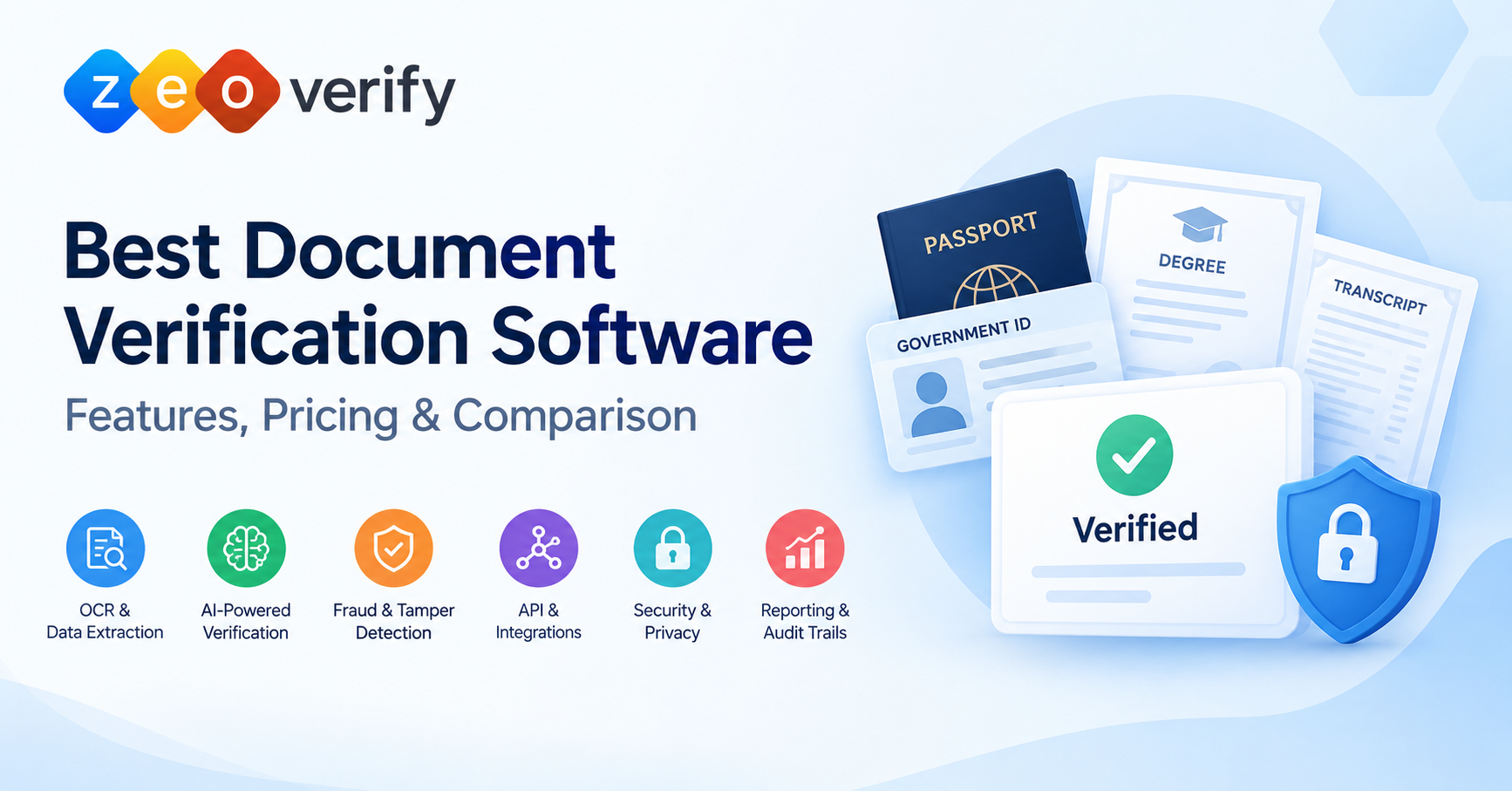
Document verification software is a category of tools that automatically checks whether a submitted document, such as a passport, government ID, academic certificate, marksheet, transcript, degree or license, is genuine and unaltered. It typically combines optical character recognition (OCR) to extract data, artificial intelligence to flag inconsistencies and fraud detection logic to catch tampering, before producing a verification decision and an auditable record.
This is different from simply uploading or storing a file. Storage systems keep a document. Verification software actively examines it, cross checks the data it contains and decides whether it can be trusted. For a broader look at how this fits into identity and compliance workflows, see our guide on document verification software.
What Should You Look for in Document Verification Software?
Before comparing individual products, it helps to know which capabilities actually affect outcomes.
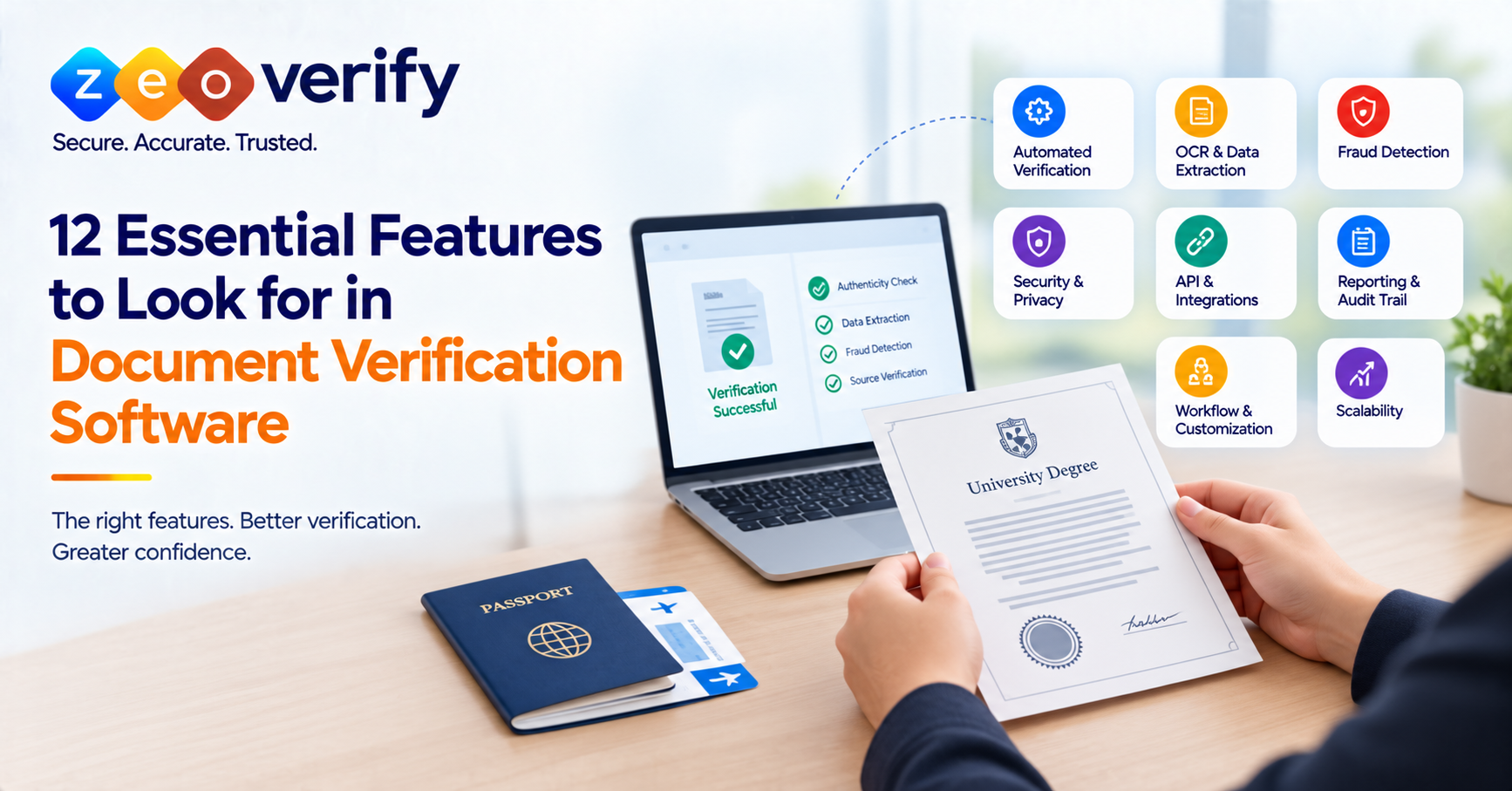
Quick feature checklist
- OCR and structured data extraction
- AI-assisted document analysis
- Fraud and tamper detection
- Security, encryption and access control
- API and integration support
- Reporting and audit trails
- Scalability for volume and document types
OCR and Data Extraction
Optical character recognition allows software to read text directly from a scanned or photographed document and convert it into structured data, instead of requiring staff to type it in manually. Better OCR engines can handle printed and handwritten fields, multiple languages and varying image quality. When comparing platforms, check which document formats and layouts are actually supported, since accuracy can vary a lot between passports, certificates and less standardised paperwork.
AI-Powered Verification
AI models are used to spot patterns that a human reviewer might miss, such as unusual formatting, inconsistent fonts or mismatched data fields. This can support fraud detection and speed up decisions, but AI should be treated as a decision support tool rather than a guarantee. No platform, including ZeoVerify, can promise complete accuracy or guaranteed fraud detection, so it is worth asking vendors how their models are trained and reviewed.
Fraud and Tamper Detection
This covers a platform’s ability to catch altered or forged documents, digitally edited images, copy paste manipulation and structural or metadata anomalies where that data is available. Some platforms focus mainly on visual inconsistencies, while others also look at file level and structural signals. Ask vendors directly which specific tampering techniques their system is built to catch.
API and Integrations
Most organisations need document verification to plug into an existing system, such as an admissions portal, CRM or internal case management tool. Look for a REST API, webhook support for real time status updates, clear documentation and a sandbox environment for testing before going live. Only take a vendor’s word on specific third party integrations if it is confirmed on their own documentation.
Security and Privacy
Because verification involves sensitive personal documents, encryption in transit and at rest, authentication controls, role based access and clear data retention policies matter. Ask how long submitted documents are stored, who can access them and whether the platform supports audit logging. Do not assume a vendor holds a specific compliance certification unless it is stated on their own site.
Reporting and Audit Trails
A verification record is only useful if it can be reviewed later. Look for detailed verification history, decision logs, user activity tracking and exportable reports, since these are often needed for internal audits or regulatory questions.
Scalability
Consider how a platform performs at your expected volume, whether it can process multiple document types concurrently, and whether it can support growth into new regions or document categories without a complete rebuild of your workflow.
How We Compared Document Verification Software
This comparison evaluates seven platforms, including ZeoVerify, using the same criteria: verification capabilities, OCR and data extraction, AI, fraud and tamper detection, API availability, integrations, security, scalability, reporting, pricing transparency and support. Information for each vendor comes from their official website, pricing pages and product documentation, along with reputable third party listings where needed. Where a capability is confirmed on a vendor’s own materials, it is marked as verified. Where pricing or a specific feature is not publicly disclosed, that is stated directly rather than estimated. No vendor, including ZeoVerify, receives different treatment or preferential criteria in this comparison. Information below was last checked in September 2026.
Best Document Verification Software Compared
Comparison Table
|
Software |
Best Suited For |
Key Features |
AI/OCR |
Fraud Detection |
API |
Pricing |
|---|---|---|---|---|---|---|
|
ZeoVerify |
Education consultants, embassies, institutions |
AI verification, DigiLocker workflow, encryption |
Yes |
Yes |
Not publicly disclosed |
Custom pricing |
|
Jumio |
Enterprise identity and compliance programs |
Document plus biometric checks, AML screening |
Yes |
Yes |
Yes |
Custom, volume based (public overviews report roughly $0.30 to $2.50+ per transaction) |
|
HyperVerge |
High volume onboarding across regions |
Document, address and deepfake detection |
Yes |
Yes |
Yes |
Custom pricing |
|
Onfido |
Enterprise KYC with strong integration docs |
Document plus biometric verification, retention controls |
Yes |
Yes |
Yes |
Custom pricing |
|
Signzy |
API-first KYC and onboarding |
One Touch KYC, database verification, biometrics |
Yes |
Yes |
Yes |
Custom pricing |
|
iDenfy |
Businesses wanting hybrid AI plus human review |
Facial recognition, liveness, document scanning |
Yes |
Yes |
Yes |
Custom pricing |
|
AuthBridge |
Education and employment background checks |
DigiLocker checks, proprietary record database |
Partial, education focused |
Yes |
Yes |
Custom pricing |
ZeoVerify
ZeoVerify is an AI powered document verification platform built around fraud prevention and secure processing of sensitive paperwork. Its confirmed capabilities include AI-based document verification, fraud prevention checks, secure transaction processing, advanced encryption and secure authentication, delivered through what the company describes as a responsive and user friendly interface. ZeoVerify also offers professional services and customizable plans aimed at embassies and education or immigration consultants, along with a DigiLocker-based document retrieval and verification workflow where applicable.
The general workflow follows document submission, verification, fraud checks, a result and reporting. ZeoVerify’s public pricing is not disclosed, so organisations interested in it should contact the ZeoVerify team directly for a quote suited to their volume and use case.
Jumio
Jumio is a long established identity verification platform combining document verification, biometric authentication, fraud prevention and AML transaction monitoring. It is commonly used by regulated enterprises that need a full identity stack rather than document checks alone. Jumio’s pricing is not published as fixed tiers. Third party pricing overviews report a volume based range roughly between $0.30 and $2.50 or more per transaction depending on the specific product and integration scope. Buyers should confirm current numbers directly with Jumio, since packaging and rates can change.
HyperVerge
HyperVerge offers document verification alongside address verification, deepfake detection and broader fraud detection tools, aimed at organisations onboarding users at scale across multiple regions. Its OCR software extracts data from passports, bank statements, payslips and other document types. Pricing is not publicly listed and is available on request through HyperVerge’s own pricing page.
Onfido
Onfido is an established enterprise identity verification vendor known for combining document and biometric checks with detailed integration documentation. Independent comparison sources describe Onfido as having solid API-first delivery and published certifications supporting its compliance posture, though a full public matrix of every supported document type is not available. Pricing is custom and provided directly by Onfido based on volume and requirements.
Signzy
Signzy provides document verification as part of a wider KYC toolkit that includes One Touch KYC, database verification across jurisdictions and biometric authentication. It positions itself for organisations that want API-first onboarding with fraud detection built in. As with most enterprise identity vendors, Signzy’s pricing is custom and not publicly listed.
iDenfy
iDenfy combines automated AI checks with human review for identity, document and account verification, which the company positions as a way to reduce false positives on subtle fraud attempts. Its verification logic covers facial recognition, document scanning and liveness detection in a single flow. Specific pricing depends on volume and is available on request.
AuthBridge
AuthBridge is primarily known for background verification, with a specific education verification service that checks marksheets, degrees and certifications, including instant checks through DigiLocker alongside its own database of verified records. It is a relevant option specifically for organisations focused on academic and employment document checks in India, rather than general purpose identity verification. Pricing is available on request.
Document Verification Software Pricing
Pricing for document verification software depends on several factors: verification volume, the number and type of documents processed, API usage, number of users, whether the deployment needs enterprise level support, contract length, geographic coverage and any additional verification capabilities such as biometric checks or AML screening. Because these factors vary so much between organisations, most vendors in this comparison, including ZeoVerify, do not publish fixed public pricing and instead quote based on a discovery call. Where a vendor does publish a pricing range, as with some Jumio overviews, that range should still be treated as a starting point rather than a guaranteed final cost, since integration complexity and add-on features affect the total.
How Much Does Document Verification Software Cost?
Subscription Pricing
Some platforms offer monthly or annual subscription plans with a fixed number of included verifications. This model suits organisations with fairly predictable volume that want cost certainty.
Pay-Per-Verification Pricing
Usage based pricing charges per document or per verification completed. This can work well for organisations with irregular or seasonal volume, though costs can rise quickly at scale if not monitored.
Volume-Based Pricing
Many enterprise vendors, including Jumio, price per transaction on a sliding scale, where the per-unit cost drops as committed volume increases. This rewards organisations that can forecast usage accurately.
Enterprise Pricing
Larger organisations with complex requirements, custom integrations or multiple document types typically move to a negotiated enterprise contract rather than a standard plan.
API Pricing
For organisations building verification into their own product, some vendors price API access separately from other services, sometimes with tiered rates based on call volume or specific enhanced features.
Custom Pricing
Several vendors in this comparison, including ZeoVerify, HyperVerge, Onfido, Signzy, iDenfy and AuthBridge, do not publish fixed prices at all. This is common in this category because requirements differ so much between a university checking a few thousand transcripts a year and an enterprise processing millions of identity checks.
What Does Document Verification Software Really Cost?
The listed or quoted price for document verification software is rarely the full cost of running it. Organisations should also budget for implementation and setup work, ongoing API usage beyond any included volume, costs tied to adding new document types, integration work with existing systems, premium support tiers, data storage, migration from a previous process and staff training. A quote that looks inexpensive on paper can end up costing more once these are added, so it is worth asking each vendor directly what is included and what is billed separately before signing a contract.
How to Compare Document Verification Software
A useful way to compare vendors is to walk through the same criteria for each one, rather than relying on marketing claims alone.
|
Criteria |
What to Check |
Why It Matters |
|---|---|---|
|
Accuracy |
Verification process and document coverage |
Affects how reliable results are day to day |
|
Fraud Detection |
Tamper and forgery detection methods |
Helps identify suspicious documents |
|
Security |
Encryption, access control, retention policy |
Protects sensitive personal documents |
|
Integration |
API, webhooks, existing systems |
Determines how much implementation work is needed |
|
Scalability |
Volume and processing limits |
Supports growth without a platform change |
|
Pricing |
Model and included usage |
Helps calculate real cost |
|
Support |
Onboarding and technical support |
Affects how smoothly implementation goes |
Ask each vendor for evidence, such as documentation, sample reports or a sandbox trial, rather than accepting a claim at face value.
Which Organizations Need Document Verification Software?
Suitability depends on document volume, risk level, how much manual verification work currently happens, existing technology and any compliance requirements.
Universities and Educational Institutions
Universities regularly need to verify certificates, marksheets, transcripts and degrees during admissions, which makes automated document verification useful for reducing manual review time and catching fraudulent academic paperwork.
Education and Immigration Consultants
Consultants who process student documents, academic records, identity documents and application paperwork on behalf of clients benefit from tools that can verify large batches of documents quickly and consistently.
Embassies and Government-Related Workflows
Embassy and visa related processes often involve checking identity and supporting documents at scale, where consistent verification criteria and clear audit trails matter for accountability.
Businesses and Enterprises
Employee documentation, customer onboarding, vendor documentation and general compliance workflows are common enterprise use cases for document verification.
High-Volume Document Processing Teams
Teams handling large numbers of documents benefit most from automation, scalability and API based workflows that reduce manual bottlenecks.
Best Document Verification Software for Different Use Cases
Rather than naming an overall winner, it is more useful to match specific priorities to the right kind of feature set.
For Education and Academic Document Verification
Prioritize platforms with strong support for certificates, marksheets, transcripts and student workflows, along with clear verification records for admissions teams.
For High-Volume Verification
Prioritize scalability, automation and proven processing capacity, along with an API that can handle concurrent requests without slowing down.
For API-First Applications
Prioritize clear API documentation, a good developer experience, webhook support, a sandbox environment and flexible integration options.
For Fraud Detection
Prioritize platforms with dedicated tamper and forgery detection along with AI based anomaly detection, and ask vendors directly what specific fraud patterns they are built to catch.
For Enterprise Workflows
Prioritize security controls, access management, auditability, scalability and the level of implementation support a vendor can offer.
Questions to Ask Before Choosing Document Verification Software
- What document types can the platform verify?
- Does it support academic documents such as certificates and transcripts?
- Does it use OCR, and which formats does it handle well?
- How does fraud detection actually work?
- Can it detect tampering, and what kind?
- Does it provide an API and webhook support?
- What integrations are available out of the box?
- How is data secured, both in transit and at rest?
- What is the data retention policy?
- What audit logs are available for review?
- How is pricing calculated?
- Is there a minimum volume commitment?
- What happens when a verification fails or is inconclusive?
- Is manual review supported alongside automated checks?
- How scalable is the platform for future growth?
- What support is included after go live?
- Is a sandbox or trial available before purchase?
- What implementation support is provided during setup?
How ZeoVerify Fits Into Document Verification Workflows
ZeoVerify is built around AI-powered document verification combined with fraud prevention, secure transaction processing and advanced encryption with secure authentication. For organisations working with sensitive paperwork, this means documents move through a workflow of submission, verification, fraud checks, result and reporting, with encryption and authentication protecting the data at each stage.
|
Buyer Requirement |
Relevant ZeoVerify Capability |
|---|---|
|
Document verification |
AI-powered verification |
|
Fraud concerns |
Fraud prevention checks |
|
Sensitive documents |
Encryption and secure authentication |
|
Embassy or consultant workflows |
Customizable plans |
|
Digital document retrieval |
DigiLocker-based workflow where applicable |
This makes ZeoVerify particularly relevant for education consultants, immigration consultants, universities and embassies that need a verification workflow tailored to their specific document types and volume, rather than a generic identity checking tool. Organisations that want to see how it fits their own workflow can explore ZeoVerify or speak with the team directly about specific requirements.
Frequently Asked Questions
What is the best document verification software?
There is no single best option for every organisation. The right platform depends on document types, volume, required integrations and budget, so it is worth comparing a shortlist against your own criteria rather than picking a single named winner.
How much does document verification software cost?
Most vendors, including ZeoVerify, price based on volume and requirements rather than publishing fixed rates. A few, like Jumio, have reported per-transaction ranges publicly, but final pricing usually depends on a direct quote.
What features should document verification software have?
Core features include OCR and data extraction, AI-assisted analysis, fraud and tamper detection, security controls, API access, reporting and audit trails, and scalability for growing volume.
How does document verification software work?
It typically follows a workflow of document submission, data extraction, authenticity and fraud checks, a verification result and a stored audit record.
Is document verification software secure?
Security depends on the specific vendor’s encryption, access control and data retention practices. Buyers should ask each vendor directly rather than assuming a standard level of protection.
What is AI document verification software?
It is software that uses AI models to help detect inconsistencies, anomalies or fraud indicators in a submitted document, generally as a support tool alongside other checks rather than a stand-alone guarantee.
What is the difference between document verification and document validation?
Document verification usually refers to confirming a document is genuine and unaltered, while validation can refer more broadly to checking that submitted information meets required rules or formats. The terms are sometimes used interchangeably by vendors.
Can document verification software detect fake documents?
Many platforms are built to flag signs of tampering or forgery, but no system can guarantee catching every fake document, so manual review is still recommended for high-risk cases.
Can document verification software verify academic certificates?
Some platforms, including ZeoVerify and AuthBridge, are specifically built for or commonly used with academic documents such as certificates, marksheets, transcripts and degrees.
Does document verification software use OCR?
Most modern platforms use OCR to extract data automatically from documents, reducing manual entry and speeding up processing.
What is a document verification API?
It is an interface that lets an organisation send documents to a verification platform programmatically and receive results back, so verification can be built directly into an existing system.
How do I choose document verification software?
Compare vendors against the same criteria, including accuracy, fraud detection, security, integration options, scalability, pricing and support, and ask for evidence rather than relying on marketing claims.
Is document verification software suitable for universities?
Yes, particularly platforms built or commonly used for academic document types, since universities regularly verify certificates, marksheets, transcripts and degrees during admissions.
Can document verification software integrate with existing systems?
Most enterprise platforms offer an API and sometimes webhooks for integration, though the depth of documentation and available integrations varies by vendor.
What should I ask before buying document verification software?
Ask about document type coverage, fraud detection methods, security practices, data retention, pricing structure, scalability and the support provided during and after implementation.