Quick Answer
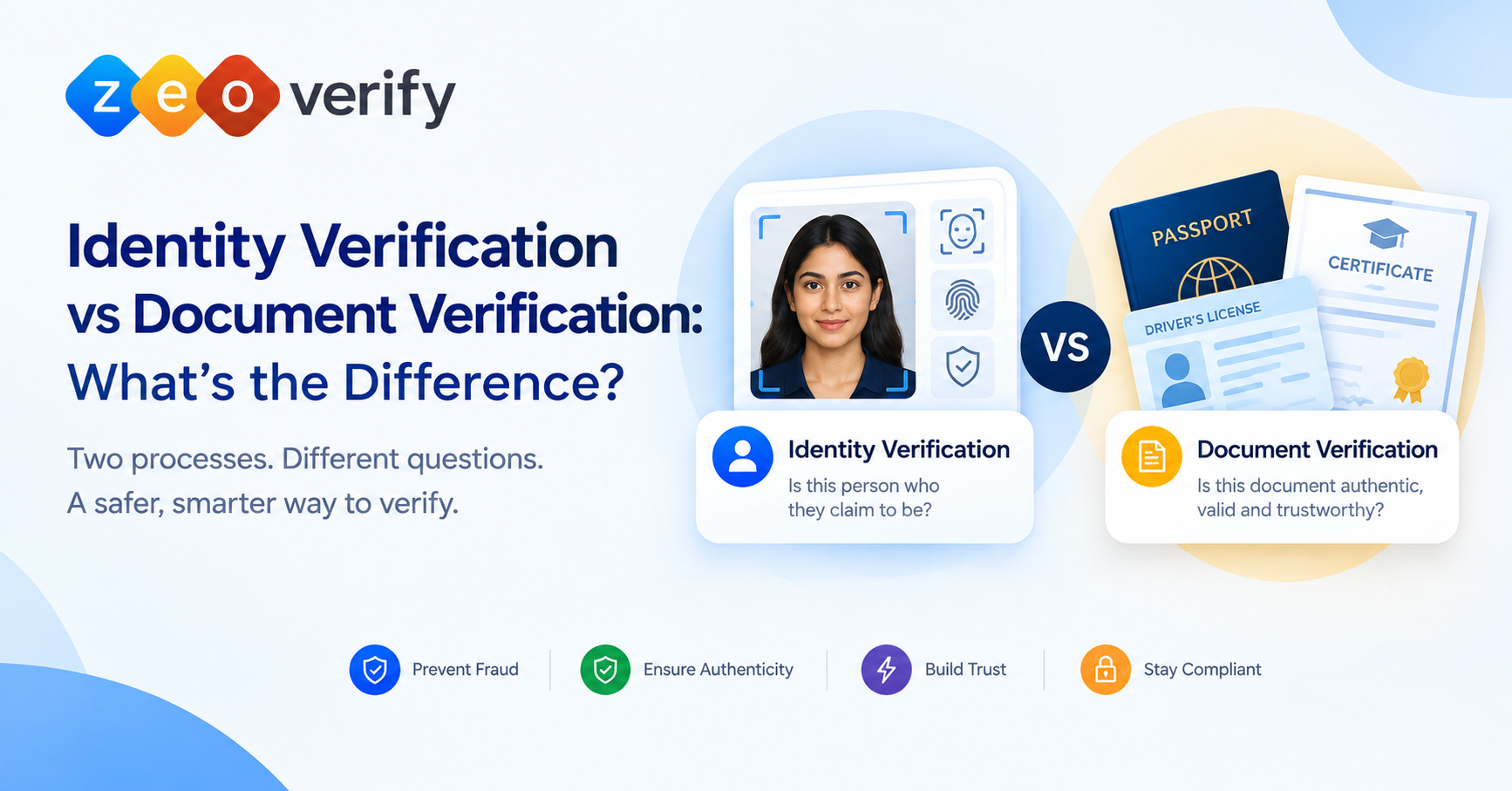
Identity verification checks whether a person is the individual they claim to be, while document verification examines whether a submitted document is authentic, valid and trustworthy. Document verification can provide important evidence within an identity verification workflow, but it does not by itself establish that the person presenting the document is its legitimate owner.
The short version: identity verification focuses on the person, document verification focuses on the evidence.
Introduction
These two terms get used almost interchangeably in everyday conversation, and it is easy to see why. Both involve checking someone’s paperwork, both show up in onboarding and KYC processes, and both aim to stop fraud before it happens. But they are actually answering two different questions.
At ZeoVerify we spend a lot of time helping universities, financial institutions and consultancies think through exactly this distinction, because the two processes call for different tools and different expectations. This guide breaks down what each term actually means, how they relate to each other and when a business needs one, the other or both.
What Is Identity Verification?
Identity verification is the process of establishing that a claimed identity actually belongs to the person going through verification. It is designed to answer one core question: is this person who they say they are?
According to NIST’s identity proofing guidance, identity verification specifically establishes the linkage between a claimed, validated identity and the real life applicant standing in front of the system. That linkage is the whole point. You can have a perfectly valid identity on paper and still need to confirm that the person in front of you is actually the one it belongs to.
It is worth distinguishing identity verification from authentication here too. Identity verification is about establishing who someone is in the first place. Authentication comes later and is about confirming that someone can demonstrate control of a credential or authenticator, like a password or a registered device, once their identity has already been established.
What Is Document Verification?
Document verification is the process of checking whether a submitted document is authentic, valid and internally consistent. It looks at authenticity, validity, integrity, information consistency, security features and any signs of tampering or forgery.
Commonly verified documents include passports, government IDs, driver’s licenses, national ID cards, certificates, academic transcripts and employment documents.
Here is the important caveat worth sitting with: a document can be validated without the process necessarily proving that the person presenting it is its rightful owner. A passport can be entirely genuine and still be held by someone who is not the person named on it. Document verification checks the evidence. It does not automatically check the person holding that evidence.
Identity Verification vs Document Verification: Key Differences
| Factor | Identity Verification | Document Verification |
|---|---|---|
| Primary purpose | Establish that an individual is the claimed person | Assess whether a document is authentic, valid and trustworthy |
| Main subject | Person or claimed identity | Document or evidence |
| Primary question | Is this person who they claim to be | Is this document genuine and valid |
| Documents | May use documents as supporting evidence | The central object being assessed |
| OCR | May support data extraction | Commonly used to extract document data |
| Biometrics | May be used for person to evidence matching | Not inherently required |
| Liveness detection | May be used in certain remote workflows | Not inherently required |
| Fraud focus | Impersonation and identity misuse | Forgery, alteration and tampering |
| KYC relationship | Contributes to establishing customer identity | Validates identity evidence used in KYC |
| Output | An identity verification decision | A document verification result |
The simplest way to remember this: identity verification focuses on the person, document verification focuses on the evidence. These two often get combined in real workflows precisely because a full identity assurance process usually needs both pieces working together.
Is Document Verification Part of Identity Verification?
Often, yes. Document verification can serve as one evidence validation component inside a broader identity verification workflow, but it is not the whole picture on its own.
Identity evidence, including a passport or government ID, gives an identity verification process something concrete to work from, providing claimed attributes like name, date of birth and identity number that can then be checked against the person presenting them.
There is a real difference between asking “is this document genuine” and asking “does this person actually correspond to the identity represented by this evidence.” NIST explicitly separates these two ideas, treating evidence validation and identity verification as distinct steps rather than one combined check. A genuine document in the wrong hands does not answer the second question.
Depending on the required assurance level, workflows might add face matching, biometrics, liveness detection, database or authoritative source checks, or other identity signals on top of document validation. None of these should be treated as universally required or automatically available on every platform. What gets used depends heavily on the specific workflow and risk tolerance involved.
Identity Verification Process vs Document Verification Process
The two processes look different in practice, even when they happen back to back in the same onboarding flow.
Typical identity verification process:
Identity information provided → Evidence collected → Evidence validated → Identity linkage checked → Additional identity signals used where applicable → Verification decision
Typical document verification process:
Document submitted → Data extracted → Document structure and security features analyzed → Information checked → Tampering or fraud indicators assessed → Verification result
Actual implementations vary a lot between platforms and providers, so treat these as general shapes rather than fixed universal steps. Where the two overlap is exactly where document verification often sits: it can appear as one stage inside a longer identity verification process, contributing the evidence validation piece before identity linkage gets checked.
What Technologies Are Used for Identity and Document Verification?
| Technology | Identity Verification | Document Verification |
|---|---|---|
| OCR | Supporting role | Core data extraction function |
| AI and machine learning | Assists matching and risk analysis | Classification, extraction and anomaly detection |
| Biometrics | Core when used for person verification | Generally not the core function |
| Face matching | Links a face to identity evidence | May appear in combined workflows |
| Liveness detection | Supports remote person presence checks | Not inherently a document check |
| Security feature analysis | May help validate evidence | Core document validation capability |
| Database checks | Can support identity resolution | Can support document or data validation |
OCR in document verification pulls text and data out of a document image so the rest of the process has something structured to work with, though it does not itself prove that document is genuine. AI and machine learning contribute pattern recognition and anomaly detection, both for spotting document inconsistencies and for supporting risk scoring in identity contexts. Biometric verification and liveness detection play a more person focused role, helping connect a live individual to their claimed identity, though neither should be treated as an automatic guarantee that identity fraud is impossible.
Identity Fraud Detection vs Document Fraud Detection
The two fraud objectives overlap but are not identical.
| Fraud Risk | Identity Verification | Document Verification |
|---|---|---|
| Impersonation | Strong relevance | Limited alone |
| Stolen identity | Strong relevance | Limited alone |
| Fake identity | Strong relevance | Limited alone |
| Fake ID or document | Supporting | Strong relevance |
| Altered document | Supporting | Strong relevance |
| Document tampering | Supporting | Strong relevance |
| Person and document mismatch | Strong relevance | Supporting |
No individual verification method should be treated as eliminating fraud entirely. Effective fraud prevention depends on the workflow, the evidence involved, the technology in place and how it all gets implemented together. Layering identity and document checks tends to close gaps that either one leaves open on its own.
Identity Verification and Document Verification for KYC
KYC identity verification and KYC document verification work together inside most compliance programs, though the specific mix required varies by jurisdiction, industry and customer risk level. Identity verification within KYC generally helps establish that a customer is who they claim to be, an obligation that shows up across banking, financial services and other regulated industries. Document verification supports this by validating the identity evidence a customer submits, such as a passport or national ID, as part of that broader process.
Because KYC requirements differ so much by jurisdiction and regulator, this article will not claim one specific method is universally required. Check the applicable regulatory guidance for your specific industry and location rather than relying on general information like this.
Identity Verification Software vs Document Verification Software
| Capability | Identity Verification Software | Document Verification Software |
|---|---|---|
| Identity data collection | Core function | Possible |
| Document analysis | May be included | Core function |
| OCR | Commonly available | Commonly relevant |
| Face matching | May be core | Not necessarily core |
| Liveness detection | May be included | Not necessarily core |
| Document authenticity checks | May be included | Core capability |
| Tampering detection | May be included | Core or highly relevant |
| Typical objective | Establish identity | Assess document or evidence |
Plenty of platforms blend both categories together, so it is worth avoiding the assumption that these two software types are always mutually exclusive. Some tools genuinely do both. What matters when evaluating a platform is checking which capability is actually its core strength rather than a secondary add-on.
When Should a Business Use Identity Verification vs Document Verification?
Choose document verification when documents are the primary evidence being assessed, certificates or identity documents need structured validation, or the business mainly needs reliable document checking without a broader identity assurance requirement.
Consider broader identity verification when the business needs to establish that a specific individual corresponds to a claimed identity, person to evidence matching genuinely matters, or additional identity signals are required beyond the document itself.
Consider both when identity assurance requirements are higher, documents need to be validated and linked back to a specific individual, or the workflow calls for multiple layers of verification working together.
Identity Verification and Document Verification Use Cases
| Workflow | Identity Verification | Document Verification | Both |
|---|---|---|---|
| Customer onboarding | Yes | Yes | Yes |
| KYC | Yes | Yes | Yes |
| Academic document checking | – | Yes | – |
| Certificate verification | – | Yes | – |
| Immigration documentation | – | Yes | Potentially |
| Remote onboarding | Yes | Yes | Yes |
| Government ID review | – | Yes | Yes |
This is particularly relevant for education consultants, universities, immigration organizations and other document heavy institutions, where document verification often carries most of the operational weight even when broader identity checks are also in place.
How ZeoVerify Supports Document Verification
Organizations handling certificates, transcripts, IDs and other high value documents can use document verification software to structure and streamline that specific part of the process. At ZeoVerify our focus is on reducing manual document checking, structuring verification workflows, supporting fraud prevention and helping teams process documents more efficiently, rather than positioning ourselves as a full identity verification platform we have not built.
If your workflow primarily involves validating submitted documents, a dedicated document verification solution can help standardize that checking and cut down on manual review. Explore ZeoVerify for secure, streamlined document verification.
Key Takeaways
Identity verification focuses on the person. Document verification focuses on the evidence. And document verification can genuinely support identity verification, but it does not automatically establish that the presenter is the legitimate owner of the document in front of them.
Frequently Asked Questions
What is the difference between identity verification and document verification?
Identity verification confirms that a person is who they claim to be, while document verification confirms that a submitted document is authentic and valid.
Is document verification part of identity verification?
It can be. Document verification often serves as one evidence validation step within a broader identity verification process.
Can document verification prove someone’s identity?
Not on its own. A genuine document does not guarantee that the person presenting it is its rightful owner.
What is biometric identity verification?
It is a method that uses physical characteristics, like a face scan, to help connect a live individual to their claimed identity.
Does OCR verify document authenticity?
No, OCR extracts text and data from a document, but the extracted data still needs separate validation to check authenticity.
Can businesses use identity and document verification together?
Yes, and many higher assurance workflows combine both to close gaps that either method leaves open on its own.